AI answer sources are pages, domains, and materials that AI models can use when generating answers to users’ questions.
In Semly, sources help you understand where AI models get information about your brand, competitors, products, services, and market category. Thanks to them, you can check why one brand appears more often in AI answers, while another is left out.
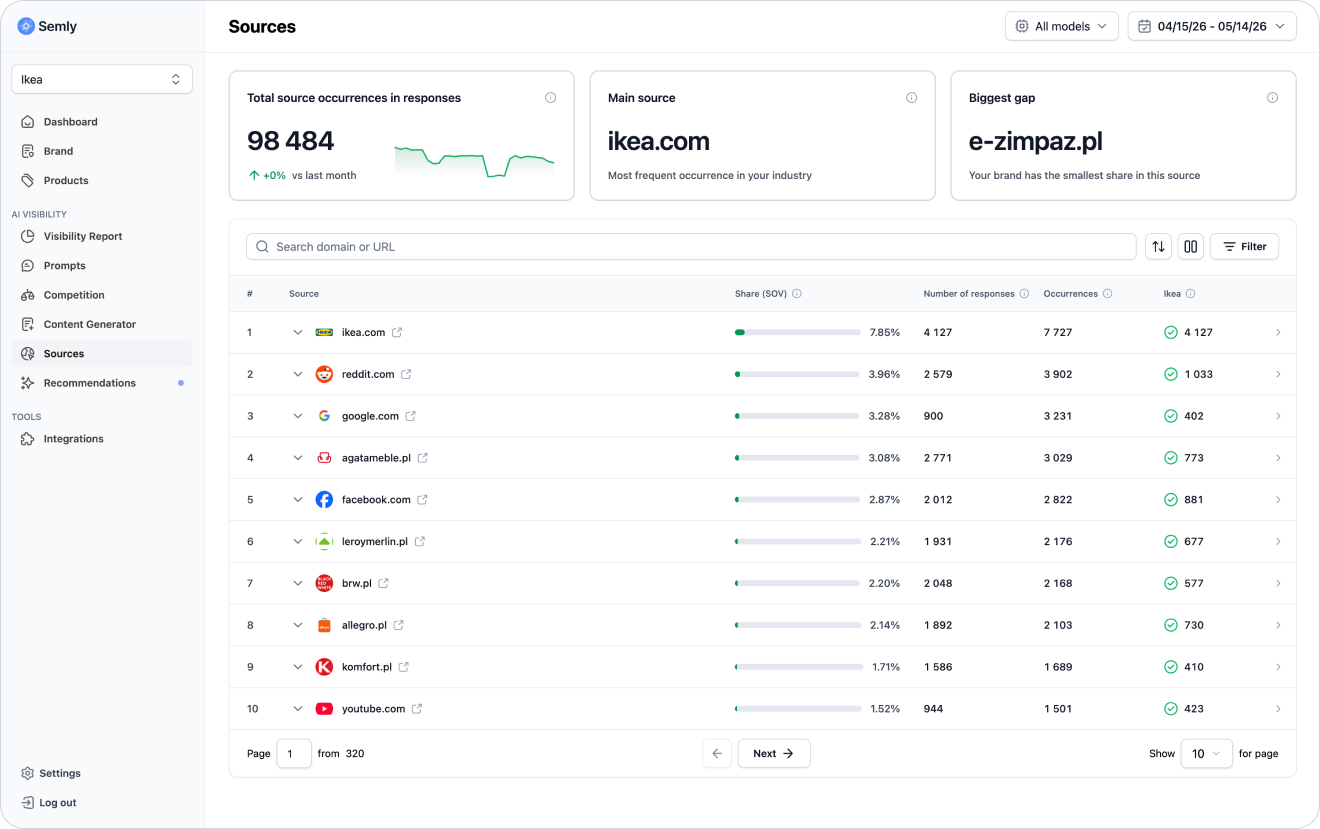
AI models don’t answer in a vacuum. When creating an answer, they use information available in different places on the Internet and data they already know or can fetch while generating the answer.
Sources can affect:
whether AI knows your brand
how AI describes your brand
whether AI recommends your brand
which competitors AI compares it with
what advantages or limitations it points out
whether information about the brand is up to date
whether the brand is visible for important prompts

Any page or material that provides information useful for the AI model can be a source.
Examples of sources:
brand homepage
category pages
product pages
blog articles
guides
rankings
comparisons
company directories
marketplaces
reviews
online forums
industry media
partner websites
manufacturer websites
knowledge bases
documentation
FAQ pages
In practice, the source can be both your own website and an external service that describes your brand, competition, or product category.

In the analysis, it’s worth distinguishing between two types of sources.
These are the sites you control.
Examples:
brand website
blog
knowledge base
FAQ
category pages
product pages
landing pages
documentation
guide subpages
Own sources are important because you can improve, update, and develop them.
These are pages you don’t have direct control over, but they can affect AI answers.
Examples:
rankings
reviews
catalogs
industry articles
forums
marketplaces
media
comparison sites
partner sites
External sources are important because they can build brand credibility or strengthen the visibility of the competition.
To go to sources:
Log in to the Semly panel
Go to the Sources section
Check the list of domains and URLs
Click a chosen source to see the details
In the Sources section you can see among other things:
a list of sources detected in AI answers
source SOV, or Share of Voice
the number of answers linked to the source
the number of source occurrences
occurrences of your brand next to a given source
sources that appear together with the analyzed source
prompts related to the source
If a source appears in Semly, it means it has been linked to the AI answers analyzed in the project.
This can mean that:
the AI model used a given page as context for the answer
a given domain was indicated as the source
content from this domain is linked to the analyzed prompt
the source appears together with your brand or your competition
a given page supports answers related to a specific category
A source doesn’t always have to mean that the model directly quoted a given page in the answer. Depending on the AI model and how it generates answers, the source can be visible as a citation, link, domain, or context used in the analysis.

Sources can either boost or limit a brand’s visibility in AI.
If many reliable sources describe your brand in a specific context, AI models can more easily connect it with users’ questions.
Example:
A user asks:
Which supplement store should I choose for sports products?
If your brand shows up in rankings, guides, industry articles and has well-described product categories, AI can have more reasons to mention it.
But if your competitors appear in many sources and your brand doesn’t, the model may recommend the competition more often.
Sources help you understand why the competition might show up more often than your brand.
If a competitor has higher visibility, check:
which sources support its visibility
does the competitor appear in rankings
does the competitor have better guides
is the competitor present in directories
does the competitor have more reviews
does the competitor have stronger category pages
is the competitor quoted more often by AI models
Example:
If AI often recommends your competitor based on rankings like “best online furniture stores,” and your brand doesn’t show up in those sources, that can be a specific visibility gap.
It’s worth analyzing sources in the context of specific prompts.
The same source can be very important for one question but irrelevant for another.
Example:
A source with a ranking of online stores can matter a lot for the prompt:
Which online furniture store is worth choosing?
But it can matter less for the prompt:
How to choose a bed with storage for a small bedroom?
So when you’re analyzing a source, check:
which prompts it appears for
whether it supports your brand
whether it supports competitors
whether it relates to the right category
whether it matches the user’s intent
whether it appears for purchase-related prompts
Source SOV, or Share of Voice, shows the share of a given source in the analyzed AI answers.
In practice, it answers the question:
How much of the source space is taken up by this domain or page?
If a source has a high SOV, it means that it appears often in the answers or is often linked to the analyzed prompts.
A high source SOV can mean that:
the model often uses this domain
the source is important in a given category
the source supports competitors’ visibility
the source can influence how brands are described
it’s worth checking if your brand is present there
Not every source has the same value.
A valuable source most often:
shows up with important prompts
relates to the right category
is up to date
contains specific information
describes brands in a comparative way
is related to the user’s intent
supports a purchase decision
is used by more than one AI model
appears together with competitors
can influence AI recommendations
Example of a valuable source:
The current ranking of online stores from a given category, where AI often finds competition and which appears for shopping prompts.
An example of a less valuable source:
An old subpage with general information that doesn’t answer any important user question.
You have the biggest influence on your own sources.
It’s especially worth developing:
category pages
product pages
shopping guides
articles that answer customers’ questions
product comparisons
FAQ
knowledge base
pages with information about delivery, returns, and payments
pages describing the brand’s advantages
local content if the company operates locally
For external sources, it’s worth checking:
rankings
industry directories
review portals
industry media
partner websites
comparison sites
marketplaces
forums and communities
Sources are often the basis for recommendations generated in Semly.
If the system detects that your brand doesn’t show up next to an important source or that competitors have an edge in a specific topic, it can suggest an action.
Recommendations can cover:
creating an article
expanding the knowledge base
improving brand data
filling in product descriptions
improving the category page
checking the robots.txt file
increasing presence in external sources
preparing content for a specific prompt
Example:
If AI often uses guides that answer the question “how to choose a bed with storage”, and your brand doesn’t have this kind of content, Semly can suggest creating an article on this topic.
When you analyze sources, you might notice a few typical situations.
Possible reasons:
the content is too generic
the website doesn’t answer the prompts being analyzed
there’s no sitemap
AI bots have trouble accessing it
important pages aren’t well linked
the content isn’t up to date
Possible reasons:
competitors show up in rankings
competition has more reviews
competition has better guides
competition is present in directories
competition has stronger external content
Possible reasons:
old articles still show up in the answers
offer information hasn’t been updated
external sites describe the brand imprecisely
AI uses archival or older data

If you don't know where to start, use a simple framework.
See which domains show up most often in AI answers.
Identify the sources with the biggest share.
Check if your brand appears next to the key sources.
See if the sources more often support your competitors.
Assess for which questions a given source matters.
Determine whether it’s a ranking, blog, forum, directory, product page, how-to guide, or another type of content.
Based on the analysis, decide whether you need to improve your own content, prepare new content, review a recommendation, or make sure you’re present in an external source.
The most common mistakes are:
analyzing just the list of domains without the context of prompts
assuming that every source has the same impact
skipping competitor sources
ignoring outdated information
not checking the details of the source
focusing only on your own website
ignoring rankings and directories
not moving from analysis to recommendations
After analyzing the sources, choose specific actions.
You can:
improve the content on your own website
expand category pages
improve product descriptions
create an article in the Content Generator
add content to the knowledge base
update the FAQ
check the robots.txt file
analyze competitors’ sources
plan PR activities or presence in directories
monitor changes in visibility over time
How to read Semly recommendations
Learn how to use Semly recommendations and turn AI analysis results into specific actions that improve your brand visibility.
How to analyze prompt details
Learn how to read prompt details in Semly and check why your brand does or doesn’t appear in AI answers.
How to interpret AI model answers
Learn how to analyze real AI model answers in Semly and check whether your brand is correctly described, recommended, and understood by artificial intelligence.
How to add competitors
Learn how to add competitors in Semly and how to use competitor analysis to check brand visibility in AI answers.
Key metrics
How to read results and metrics in Semly. A guide to brand visibility analytics in AI answers.
AI answer sources show where models can get information about your brand, competitors, and category. Thanks to them, you can better understand why AI recommends certain companies and what affects your brand visibility.
Most important rules:
analyze sources together with prompts
check SOV (Share of Voice) of the sources
compare your own and external sources
check which sources support the competition
look for gaps in important sources
develop content that answers customers’ questions
use sources to plan recommendations and actions