Prompts are one of the most important elements of visibility analysis in Semly. Based on them, the system checks whether your brand appears in the answers of AI models such as ChatGPT, Gemini, Claude, Grok, Google AI Overviews or Google AI Mode.
Well-prepared prompts help you check whether AI recommends your brand for questions that your potential customers might ask.
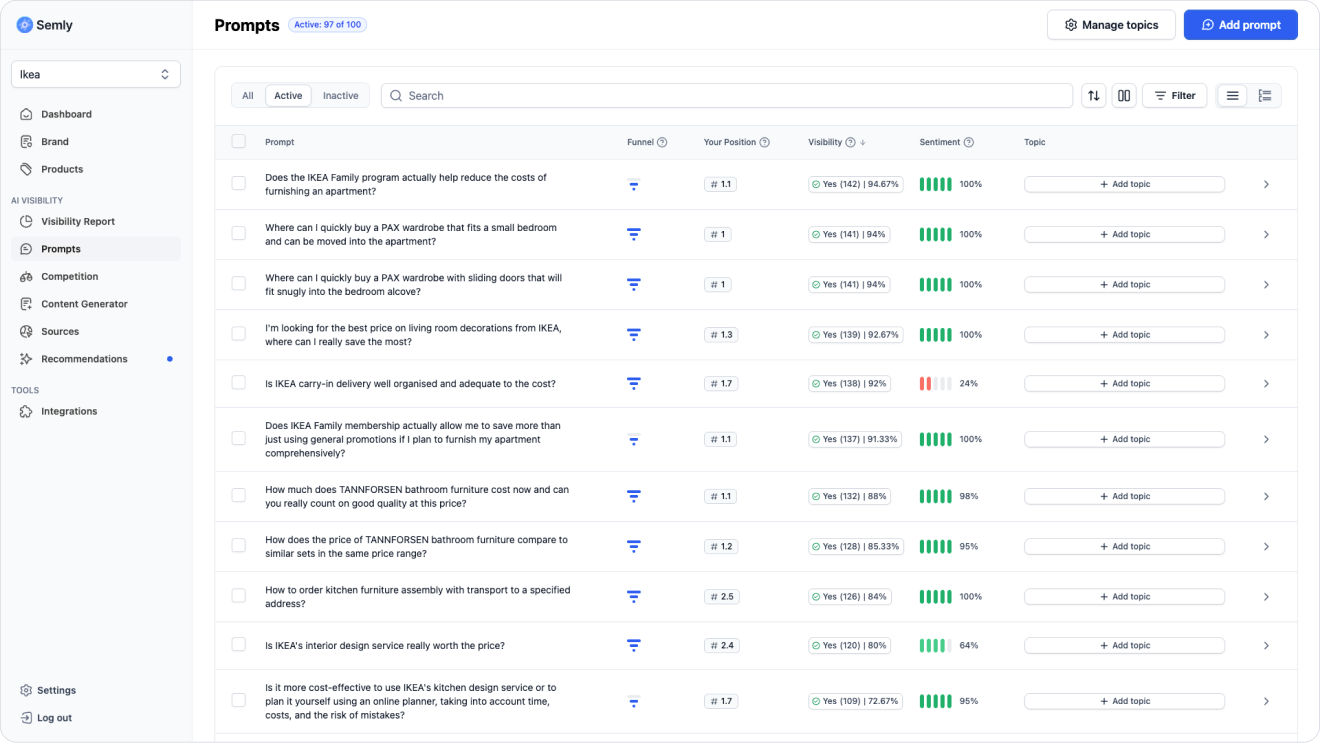
A prompt is a question or instruction entered into an AI model.
In Semly, a prompt represents a real user intention, meaning a situation where a potential customer is looking for a product, service, brand, comparison, or recommendation.
In classic SEO, a user might type a short phrase:
living room furniture
In AI, they’re more likely to ask a fuller question:
I’m looking for a store where I can order modern living room furniture with delivery and assembly. Where’s the best place to look for it?

Prompts define in which situations Semly will check the visibility of your brand.
Thanks to prompts you can see:
whether AI knows your brand
for which questions the brand appears
when AI recommends the competition instead of you
in which position your brand appears
what sentiment the answer has
which sources AI models use
which questions have the biggest sales potential
Well-chosen prompts let you analyze not only the general visibility of the brand but also specific customer needs.

To go to prompts:
Log in to the Semly panel.
Choose the right project.
Go to the Prompts section.
Check the list of active prompts.
Add a new prompt or go to the details of an existing question.
In the Prompts section you can see among other things:
prompt content
average brand position
visibility
sentiment
assigned topic
activity status
AI models covered by the analysis
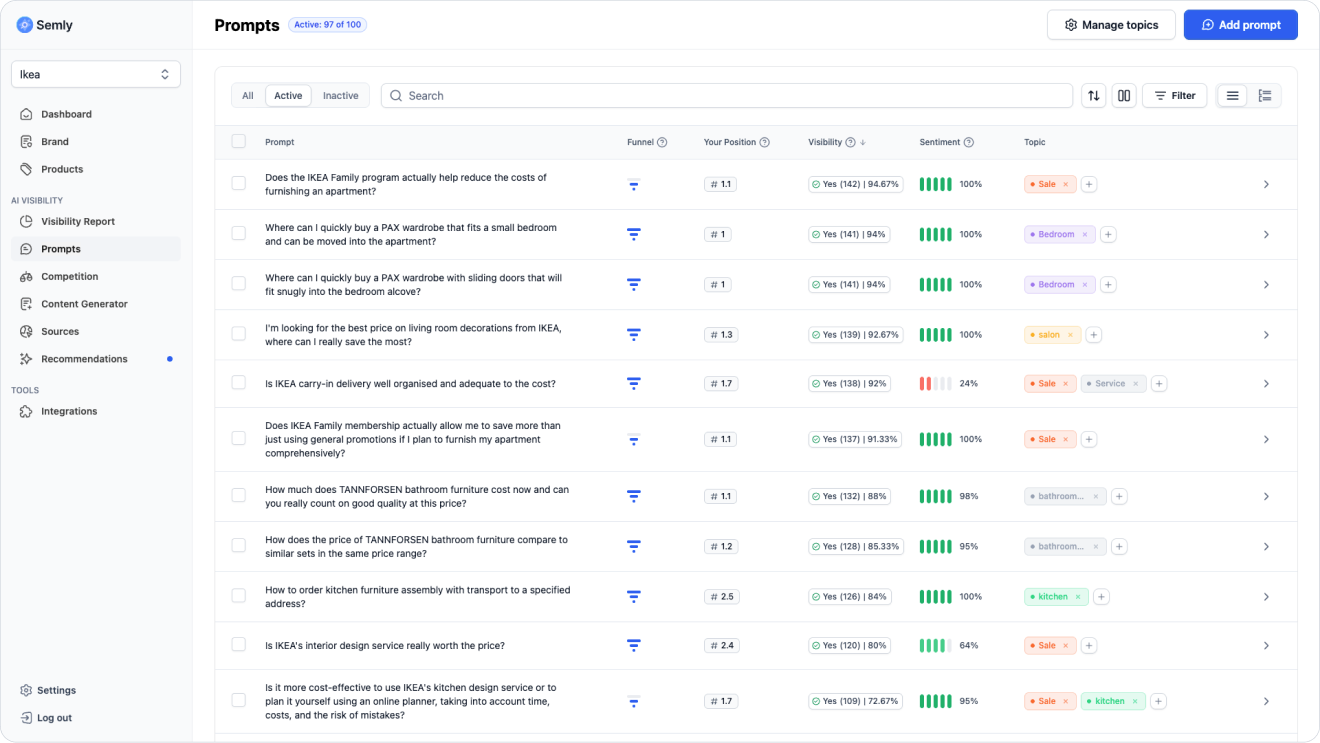
A good prompt should be specific, natural, and similar to a question a user might ask AI.
A good prompt usually includes:
user need
context of the situation
product or service category
expected result
sometimes location
sometimes budget
sometimes shopping preferences
Example of a weak prompt:
bed with storage
Example of a better prompt:
Where to buy a comfy bed with storage for a small bedroom?
Example of a weak prompt:
e-commerce platform
Example of a better prompt:
Which platform should I choose to run an online store with the option to integrate with wholesalers?
A prompt doesn’t work the same way as a classic SEO phrase.
An SEO phrase is usually short and based on keywords.
A prompt is closer to a conversation with AI and can include more context.
Example of an SEO phrase:
supplements for athletes
Example of a prompt:
Which supplement store for people doing strength training is worth choosing?
Example of an SEO phrase:
natural cosmetics
Example of a prompt:
Where to buy natural cosmetics for sensitive skin?
Example SEO phrase:
furniture store
Example prompt:
Recommend a store with functional furniture for a small apartment

To add a new prompt:
Go to the Prompts section
Click Add a single prompt or choose the option to add multiple prompts in bulk
Type in the question content
Save changes
After adding a prompt, Semly can start analyzing the AI answers for this question. You can also assign prompts to selected topics.
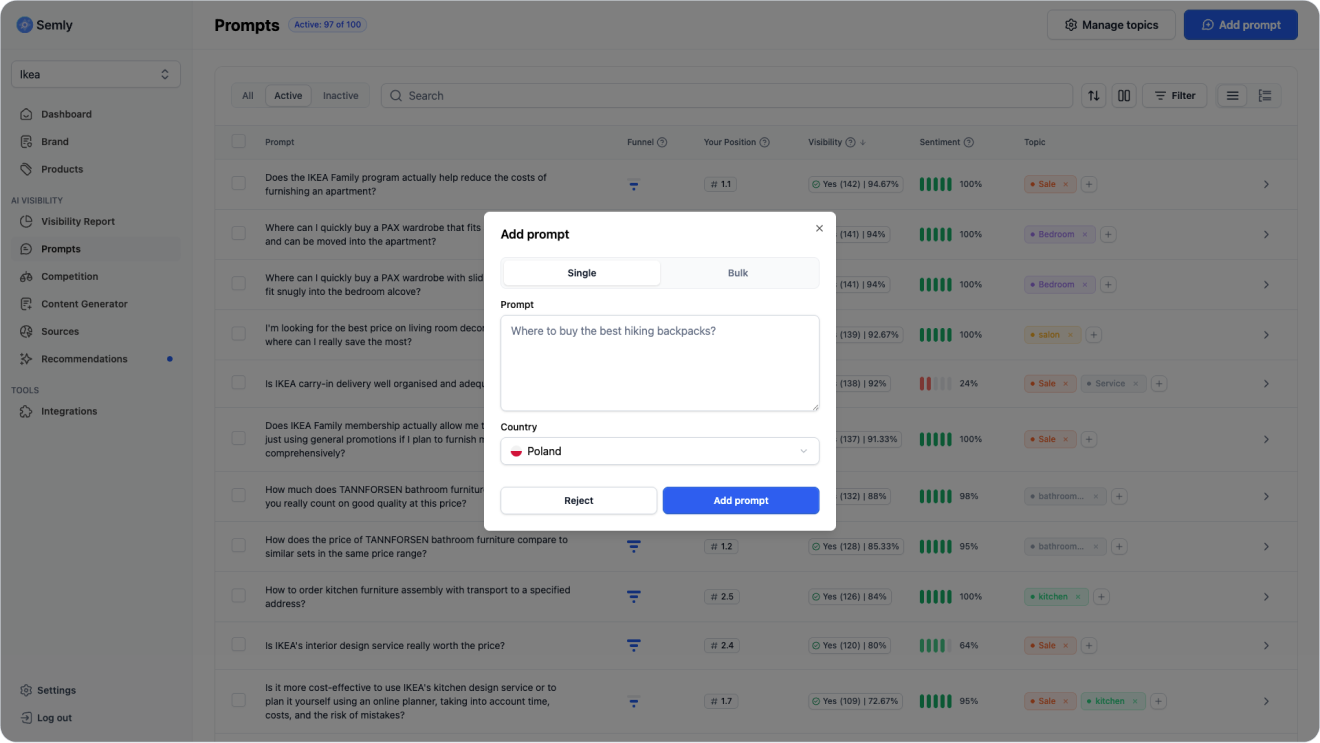
At the beginning, it’s worth adding prompts that match the most important buying or decision-making situations for your customers.
Ask yourself:
what could a customer ask AI before buying
for which questions should my brand be recommended
what problems does my offer solve
which competitors might customers compare me with
which product categories are the most important
which services have the highest sales value
which questions show readiness to buy
Example for a furniture store:
Where to buy a bed with storage for a small bedroom
Which furniture store offers good value for money
Recommend a store with functional shelves and TV cabinets
Where to buy modern living room furniture with delivery
Which online furniture store is worth choosing
Example for a supplement store:
Which supplement store for athletes is worth choosing
Where to buy creatine and a protein supplement online
Recommend a store with good-quality vitamins and supplements
Where to buy supplements for physically active people
Which store offers fast supplement delivery
Example for a service company:
Which company should I choose to create an online store
Where can I find a good dermatologist in my area
Recommend an accounting office for a small business
Which agency will help increase sales in e-commerce
Which payment system provider should I choose for an online store
In e-commerce, prompts should relate to products, categories, use cases, comparisons and shopping situations.
You can create prompts around areas like:
product selection
brand comparison
user need
budget
delivery
availability
quality
product use
specific category
problem to solve
Examples:
Which online furniture store offers good prices and fast delivery?
Where to buy natural cosmetics for sensitive skin?
Which packaging should I choose for homemade cosmetics?
Which supplement store has a wide range of products for athletes?
Where to buy an elegant waist bag from a Polish brand?
In services, prompts often relate to the client's problem, location, urgency, specialization, or trust in the provider.
You can create prompts around areas like:
choice of specialist
location
client's problem
delivery time
comparison of providers
experience
price
safety
recommendations
fit for needs
Examples:
I urgently need to consult a dermatologist, preferably from my area. Who is worth choosing?
Which company should I choose to handle the accounting for a small company?
Which agency will help me increase sales in my online store?
Where can I find a specialist to implement an online store for B2B?
Which CRM system provider should I choose for a small company?
In B2B, prompts are often longer and more decision-oriented. A user may ask AI about a tool, a provider, a comparison of solutions, or a recommendation for a specific type of company.
Examples:
Which tool should I choose to monitor brand visibility in AI?
Which e-commerce platform will work well for a manufacturer selling B2B?
What solution will help me automate importing products from wholesalers?
Which platform should I choose for selling online in multiple markets?
Which system will help analyze brand visibility in ChatGPT and Gemini?
Topics let you group prompts into logical sets.
With topics, you can more easily analyze your brand visibility in specific areas, e.g. for selected product categories, services, funnel stages, or customer groups.
Examples of topics:
Living room furniture
Beds and mattresses
Supplements for athletes
Natural cosmetics
E-commerce platform
Dropshipping
Local services
Comparisons with competitors
Shopping prompts
Educational prompts
To add a topic:
Go to the Prompts section.
Open topic management.
Click Add topic.
Enter the topic name.
Choose a color if the panel lets you tag topics with colors.
Save the topic.
Assign selected prompts to the topic.
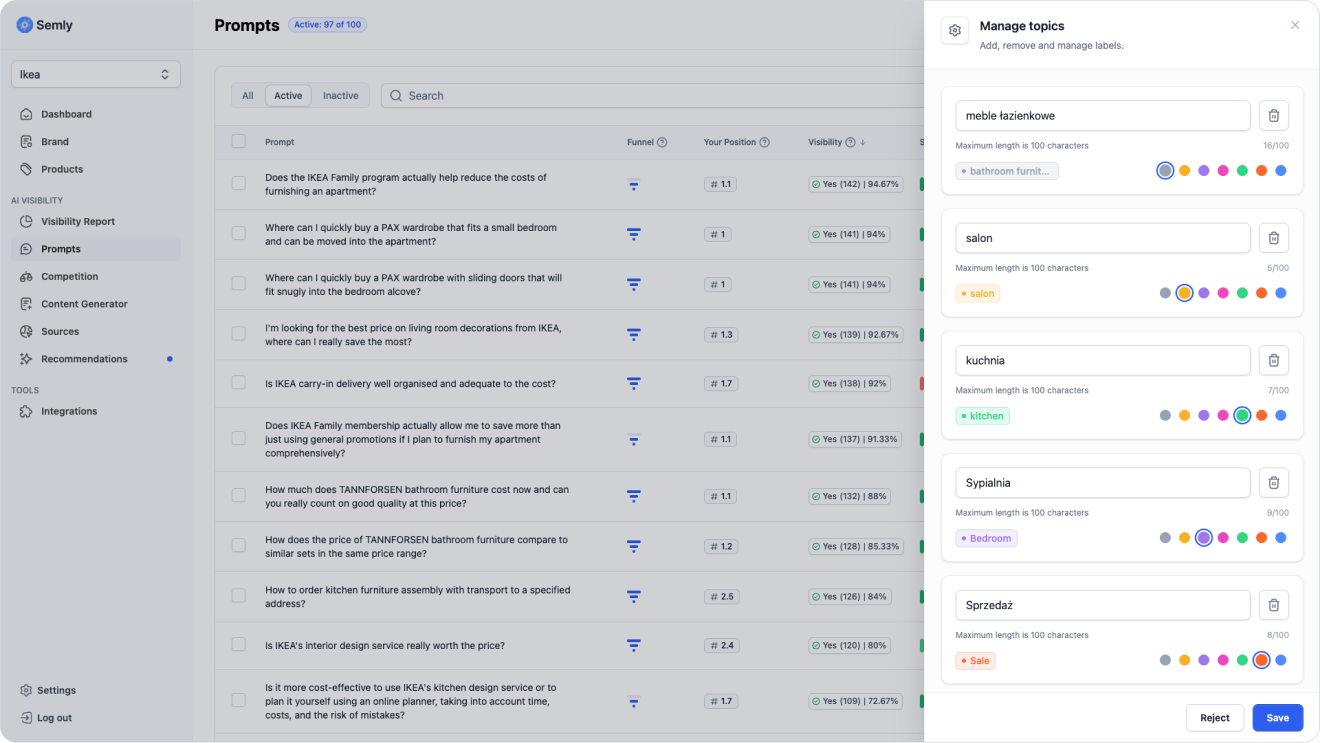
The topic name should be short, clear, and easy to understand for the person analyzing the report.
Good topic names:
Living room furniture
Premium products
Purchase questions
Brand comparisons
Delivery and availability
Online stores
E-commerce integrations
Sports supplements
Natural cosmetics
Local services
Weak topic names:
Miscellaneous
Test
General
Prompts 1
New
Other
You can group prompts using different criteria.
The most common ways to group them:
by product category
by type of service
by customer decision stage
by purchase intent
by market or language
by target group
by competition
by user problem
by campaigns or marketing activities
Example for a furniture store:
Topic: Beds and mattresses
Where to buy a bed with storage for a small bedroom
What kind of bed to choose for a teenager's room
Recommend a comfy double bed with delivery
Where to buy a mattress for side sleeping
Topic: Living room furniture
Where to buy modern living room furniture
Recommend a store with TV cabinets and dressers
What furniture to choose for a small living room
Where to buy a bookshelf for the living room at a good price
Topics help you check which areas the brand is visible in and where it has gaps.
Thanks to topics you can analyze:
visibility for the whole category
brand position in a specific area
sentiment for a given type of questions
prompts with the biggest potential
areas where the competition is winning
sources supporting specific categories
recommendations related to the selected topic
Example:
If a brand has high visibility in the topic of Living room furniture, but low in the topic of Beds and mattresses, you can more quickly spot where it’s worth expanding content, improving product data, or adding new prompts.
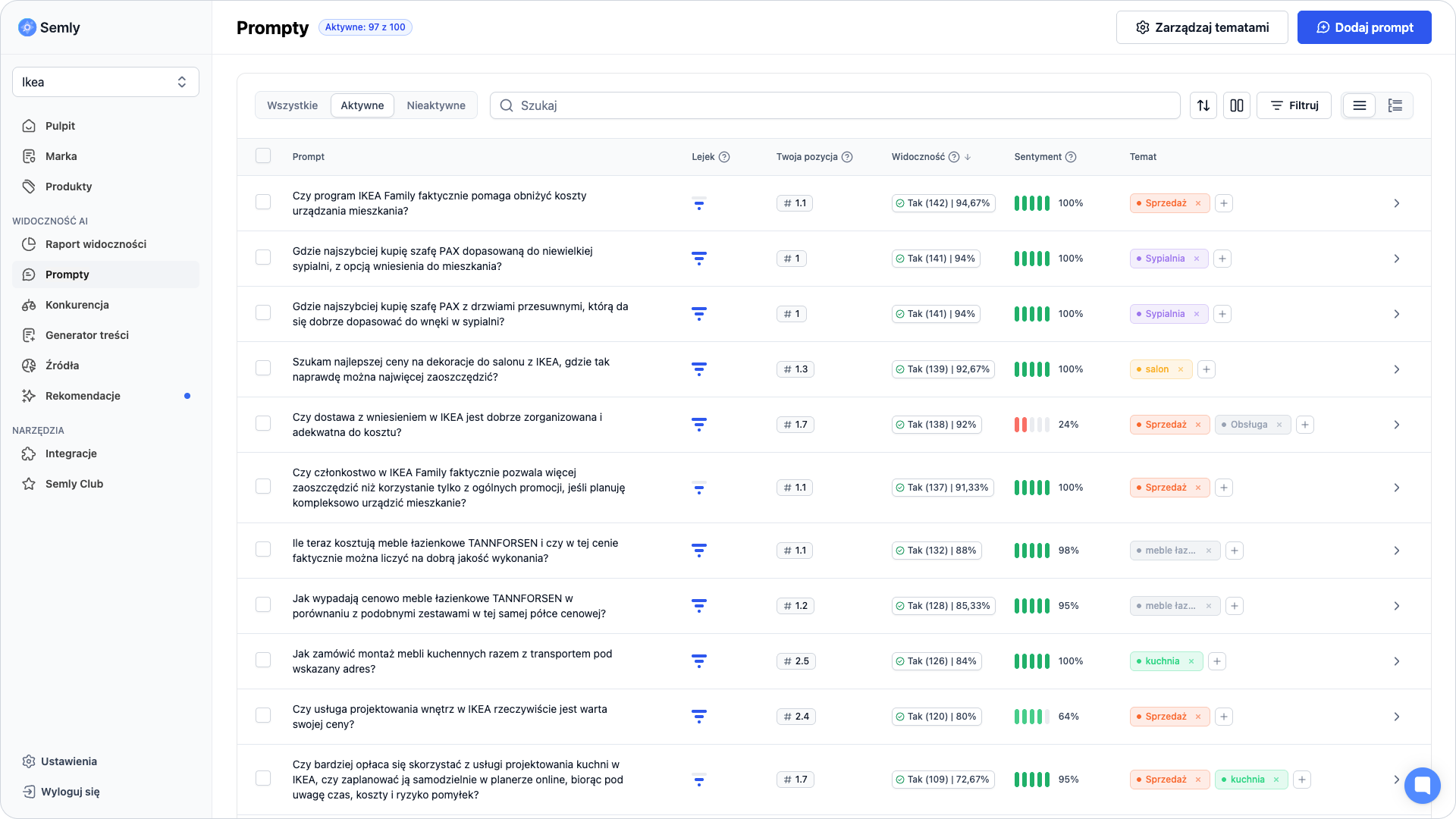
The more well-chosen prompts you add, the fuller picture of the market you’ll get in Semly. A higher number of questions lets you better check for which customer intents your brand is visible, where the competition shows up, and in which areas you have the biggest gaps.
Keep in mind though that it’s not just the number of prompts that matters, but their quality too. The best prompts should reflect real customer questions, different stages of the purchase decision, and the most important categories of products or services.
A broader set of relevant prompts gives you better market coverage and helps Semly detect more visibility gaps across categories, intents, competitors, and stages of the customer journey.
Avoid prompts that are too short, generic, artificial, or don’t reflect real user behavior.
Avoid prompts that consist only of single keywords, such as:
shoes
store
cosmetics
price
products
ranking
company
test
brand
promotion
Also avoid prompts that:
are too general
have no context
don’t indicate the user’s need
contain only keywords
are written in the company’s internal language
are about products or services you don’t offer
are unrealistic
are too similar to each other

If a prompt is too general, add some context to it.
Weak prompt:
cosmetics store
Better prompt:
Where to buy natural cosmetics for sensitive skin?
Weak prompt:
ecommerce platform
Better prompt:
Which platform should I choose to run an online store with integrations with wholesalers?
Weak prompt:
supplements
Better prompt:
Which supplement store for people doing strength training is worth choosing?
Weak prompt:
accounting
Better prompt:
Which accounting office should I choose for a small online business?
It’s worth updating prompts when your offer, the market, or the way customers ask about products and services changes.
Update prompts when:
your brand or the indicated competition doesn’t show up in AI’s answers
you’re adding a new product category
you’re entering a new market
you’re launching a new service
the target group is changing
a new competitor appears
you’re seeing new customer questions
sales seasonality is changing
the report shows gaps in specific topics
the recommendations point to a need to create new content
After adding prompts, it’s worth moving on to result analysis.
Check:
whether the prompts are active
whether topics are assigned
whether the brand appears in the answers
what the brand’s average position is
what the sentiment of the answers is
which competitors appear most often
which sources influence the answers
whether Semly generated recommendations for these prompts
How to complete a brand profile
Learn how to correctly fill in brand data in Semly so the system can better analyze your company's visibility in AI answers
How to add products or a Google Shopping XML file
Learn how to add products to Semly using a Google Shopping XML file or a ready-made integration, and why up-to-date product data is important for analyzing brand visibility in AI.
How to add competition
Learn how to add competitors in Semly and how to use competition analysis to check brand visibility in AI answers.
How to read the Visibility Report
Find out how to analyze the Visibility Report in Semly and check how your brand appears in AI answers.
Key indicators
How to read results and indicators in Semly. A guide to brand visibility analytics in AI answers.
Prompts define for which questions Semly checks your brand’s visibility in AI. The better they reflect real customer needs, the more valuable the analysis results will be.
The most important rules:
create prompts in the form of natural questions
add the user’s context and intent
avoid short SEO phrases
group prompts into topics
analyze prompts by visibility, position, and sentiment
update prompts along with changes in the offer
use the results to create content and implement recommendations